The word Pyjamaspapper looks unusual enough to make almost anyone stop and wonder what it means. At first glance, it can seem like a modern internet expression, a Scandinavian fashion term, or even a playful combination of words related to sleepwear and paper. That uncertainty is part of what makes the term interesting.
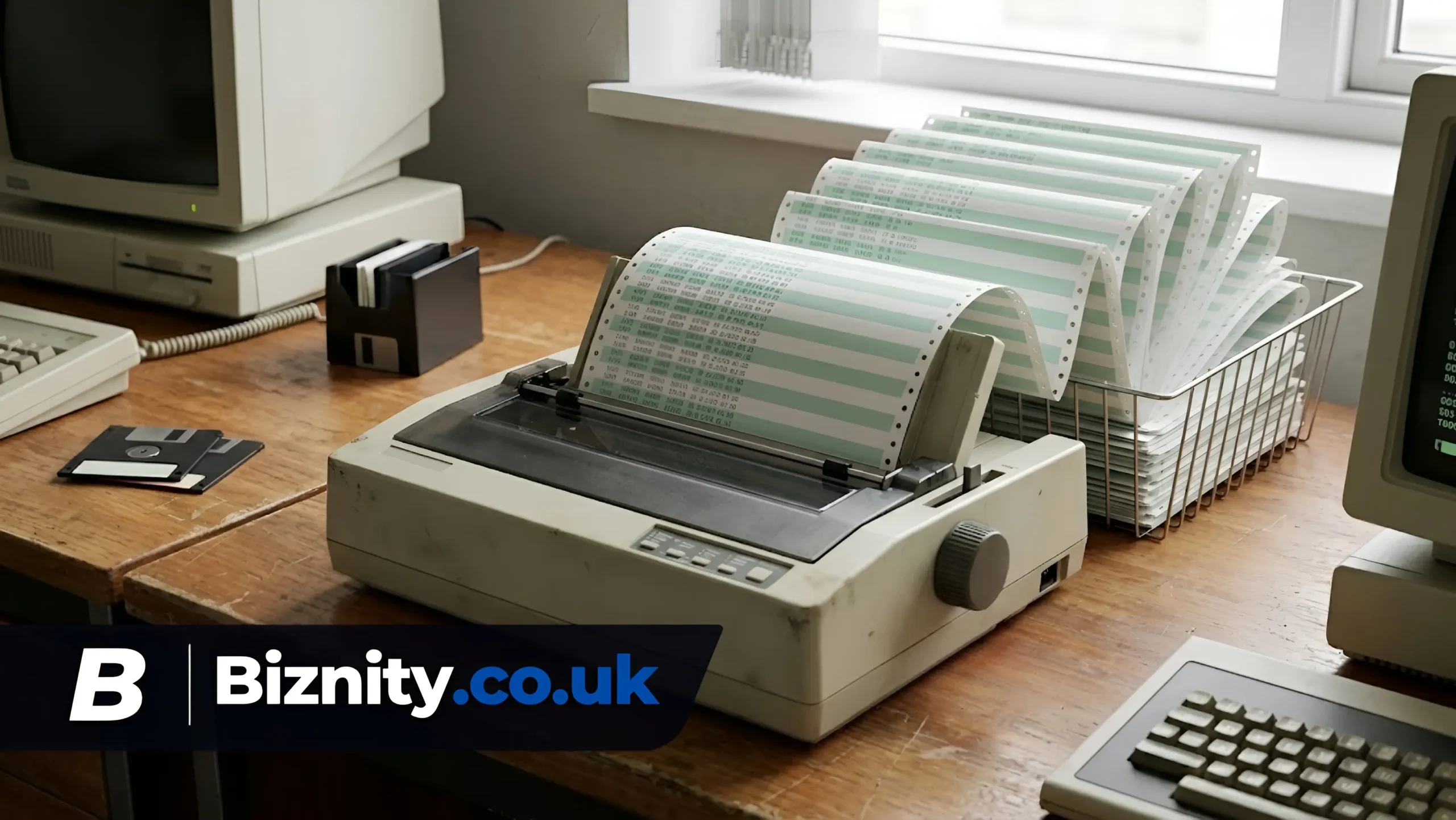
In Swedish usage, however, pyjamaspapper is associated with an older kind of continuous computer paper: long, connected sheets designed to move through printers using tractor-feed mechanisms, often recognized by their striped appearance and perforated side strips. Swedish historical accounts also use the word when describing paper that carried long computer-generated lists, records, technical material, and other printed output.
That practical meaning is much more interesting than the word may initially suggest.
Before modern laser printers, cloud dashboards, digital archives, and searchable PDFs became ordinary parts of office life, printed computer output had a very different physical form. Information could emerge from a machine as a long, continuous stream of paper. It could stretch across desks, be torn into sections, reviewed line by line, stored in folders, or carried from one department to another.
Pyjamaspapper belongs to that world.
It represents a small but memorable piece of computing history: the period when digital information was still routinely converted into very physical, very tangible paper. For people who worked around older computer systems, the term could immediately bring to mind striped pages, perforated edges, noisy printers, long reports, and stacks of printed records.
Today, the word is especially interesting because it sits between language, technology, office history, and nostalgia. Some modern online pages interpret it incorrectly or give it symbolic meanings that are not well supported. Swedish computing-related material provides a much more concrete interpretation: pyjamaspapper refers to continuous, striped computer paper used with older printing systems.
This guide explores what Pyjamaspapper means, how it was used, why it developed such a distinctive appearance, what made it useful, why it became less common, and what modern businesses can learn from this seemingly ordinary piece of paper.
What Is Pyjamaspapper?
Pyjamaspapper is a Swedish term associated with continuous-feed computer paper, particularly the type of paper that was commonly used with older printers and terminal systems.
Rather than existing as separate A4-style sheets, this paper typically came in a long connected form. It could be folded into sections, stored in large stacks, and fed continuously through a printer.
Its most recognizable feature was its visual appearance.
Many examples were printed with alternating light and darker horizontal bands, creating a striped pattern. That pattern made large amounts of printed text easier to scan because the eyes could more easily follow information across a wide page.
Another important feature was the paper’s feeding system. Continuous computer paper was commonly designed with perforated edges or tractor holes. Those holes allowed the printer mechanism to grip and advance the paper consistently.
One Swedish historical account describes pyjamaspapper as striped computer paper with perforated side strips, while another computing text describes it as striped paper used for printed computer commands and results from older terminal-style systems.
So, despite the amusing name, Pyjamaspapper was fundamentally practical.
It was not created simply to look unusual. It was part of a printing system designed around the technical realities of early and transitional computing environments.
Why Does Pyjamaspapper Have Such a Strange Name?
The name is one of the most fascinating parts of Pyjamaspapper.
Modern readers who see the word without context may naturally try to connect it with pajamas. That interpretation is understandable because “pyjama” resembles the first part of the word.
The second part, however, is important.
In Swedish, papper means paper. That makes the literal structure much more connected to paper than to the idea of a person wearing pajamas.
The striped appearance of the paper likely contributed to the memorable nickname. Just as people casually create names for objects based on their shape, color, texture, or visual pattern, a distinctive striped paper product could easily acquire an informal name that stuck among users.
The result is a term that sounds playful while referring to something highly technical.
That contrast helps explain why Pyjamaspapper remains memorable.
A standard technical description such as “continuous tractor-feed computer paper” is accurate but dry. Pyjamaspapper is easier to remember. It carries personality, even though the object itself was a basic office and computing supply.
Pyjamaspapper and the Early Age of Computer Printing
To understand Pyjamaspapper properly, it helps to understand what computing felt like before screens became the primary way people interacted with information.
Today, a computer can create a report and display it instantly. A user can search it, copy a section, email it, store it online, and access it from another device.
Earlier systems often worked very differently.
Computer output was frequently printed because digital information was not always convenient to view or preserve electronically. A printed record could serve as proof, a working document, a reference, or a way to review a large amount of information away from the machine.
This made continuous computer paper extremely useful.
A machine could print one line after another without stopping after every standard page. The paper simply continued moving through the printer.
For long reports, this approach made sense.
Imagine an operations team needing a list containing hundreds or thousands of records. Instead of receiving the information as separate sheets, the printer could produce one continuous document that could later be separated into manageable sections.
That workflow may look primitive now, but at the time it could be extremely efficient.
The Classic Look of Pyjamaspapper
When people think about Pyjamaspapper, the striped appearance is one of the first visual details that often comes to mind.
The alternating bands were more than decoration.
Large printed lists can be surprisingly difficult to read, especially when every row contains several columns. Without visual separation, it is easy for the eye to drift from one row into another.
Horizontal banding helps establish structure.
A reader looking at a long list can follow one line across the page more confidently. When the page contains inventory numbers, names, dates, codes, prices, or other structured information, this small visual improvement can make a difference.
This is particularly useful when a document contains repeated data rather than normal paragraphs.
For example, imagine a printed report containing:
- Product code
- Quantity
- Warehouse location
- Order number
- Customer reference
- Status
If hundreds of lines are printed one after another, readability becomes a practical concern.
A striped background can make each horizontal line feel visually separated without requiring boxes around every field.
This is one reason the visual identity of Pyjamaspapper is so closely linked with lists and computer-generated reports.
Perforated Edges: Another Defining Feature
Another important characteristic of traditional continuous computer paper was the use of perforated edges.
These edges served a mechanical purpose.
Printer systems needed a reliable way to move paper forward. Tractor-feed mechanisms could engage with holes or perforations along the sides of the paper, allowing the machine to advance each section accurately.
For the user, that meant the paper could travel through the printer in a controlled way.
After printing, the perforated side sections could often be removed.
The result was a useful combination of machine compatibility and human convenience.
During printing, the side strips helped the machine handle the paper.
After printing, those strips could be separated so the final document looked cleaner.
This design is a good example of how older office equipment frequently combined several functions into one physical format.
How Was Pyjamaspapper Used?
The word can be understood most clearly by looking at the types of work that benefited from continuous computer paper.
The paper was particularly suited to tasks where a large quantity of structured information had to be printed quickly.
Common applications included long lists, reports, logs, records, computer output, administrative documents, and operational paperwork.
A useful way to think about it is this:
Pyjamaspapper was not primarily about presentation. It was about output.
The emphasis was on getting information from a machine onto paper in a dependable and efficient way.
That distinction matters.
A company producing a glossy annual report would choose a very different kind of paper.
A business printing a long inventory list, transaction record, system log, or order report needed something functional.
Continuous-feed paper was designed for exactly that kind of environment.
Pyjamaspapper in Offices
One of the most natural environments for Pyjamaspapper was the office.
Before digital business systems became deeply integrated, departments frequently depended on printed lists.
A report might be produced by one employee and physically carried to another.
A list of orders might be printed and given to a production manager.
A stock report might be printed for review during a meeting.
A customer record might be printed for administrative processing.
The printed document could become the working version of the information.
A modern employee might consider this inefficient, but it provided something digital systems sometimes lacked at the time: an easily handled physical object.
Paper could be marked with a pen.
People could circle an item.
They could write notes in the margin.
Several employees could examine the same report at once.
It could be placed on a desk and referenced throughout the day.
In that sense, Pyjamaspapper was not merely printer paper. It was part of an information-management workflow.
Pyjamaspapper and Long Lists
Long lists were one of the environments where continuous paper made particular sense.
A standard sheet has a natural stopping point. Continuous paper does not.
That makes it ideal for information that needs to flow continuously from one record to another.
Picture a business printing a large order list.
The printer can produce row after row without requiring an employee to stop, remove a page, and insert a new one.
For repetitive data, that process can be much more practical.
Historical accounts describe pyjamaspapper being used for long lists such as orders and computer-generated records.
The result was a very different relationship between people and printed information.
Instead of thinking in terms of individual pages, users often thought in terms of runs, stacks, or long printouts.
That is one of the reasons the material remains culturally interesting today.
Pyjamaspapper in Technical Environments
Technology-focused workplaces were another natural fit.
Older computing systems often generated output that was primarily textual. Before modern graphical interfaces became standard, users frequently interacted with computers through terminals and command-oriented systems.
In some environments, commands and results were printed line by line.
The paper became a physical history of what the system had done.
A technical user could look back at a printout and compare entries, locate a result, or examine what had happened during a process.
A Swedish computing text specifically describes older terminal-style systems producing output line by line on striped pyjamaspapper.
That gives Pyjamaspapper an interesting role in computing history.
It was effectively one of the physical interfaces between a person and a machine.
Today, that interface is usually a screen.
Earlier, it could be paper.
Why Continuous Paper Made Sense Before Modern Printers
It can be tempting to look at Pyjamaspapper and wonder why anyone would use such a format.
The answer is simple: the technology of the time shaped the workflow.
Continuous-feed systems had several practical advantages.
They could handle long print jobs without requiring constant page changes.
They were well suited to structured reports.
They worked effectively with mechanical feeding systems.
They allowed businesses to process printed output in large batches.
For organizations with recurring reports, these characteristics mattered.
A company did not necessarily need visually attractive pages. It needed reliable output.
The paper was therefore an important component in a broader system that connected software, computers, printers, employees, and physical records.
What Did Pyjamaspapper Feel Like to Use?
The experience of using old continuous-feed computer paper was very different from printing a document at home today.
There was more mechanical movement.
The printer physically pulled the paper through.
The output could be surprisingly long.
Users often had to deal with stacks, folds, perforated edges, and large piles of printed material.
The printer itself was part of the environment.
Modern printing is often quiet and visually simple.
Older computer printing could feel more industrial.
That physical quality is part of the nostalgia associated with Pyjamaspapper.
For people who remember the era, the paper can represent an entire office atmosphere rather than just an object.
It can evoke the sound of printing equipment, the appearance of computer rooms, stacks of reports, paper trays, filing systems, and long administrative routines.
Pyjamaspapper as a Symbol of an Older Digital World
The interesting thing about Pyjamaspapper is that it sits at the intersection of digital and physical culture.
The information printed onto the paper was digital.
The document itself was physical.
This created a transitional form of information management.
People were using advanced computing systems, but the output still ended up on paper.
That may sound contradictory today, but for many years it was normal.
The concept provides a useful reminder that technology does not change overnight.
Digital transformation usually happens gradually.
One system replaces another.
One workflow becomes automated.
Paper survives in some areas while disappearing in others.
Pyjamaspapper belongs to one of those transitional periods.
Why Did Pyjamaspapper Become Less Common?
The decline of traditional continuous computer paper is closely connected to the broader digitization of business.
As computers became more capable, organizations gained better options for storing, reviewing, and sharing information electronically.
Screens became larger.
Software became more visual.
Databases became easier to search.
Digital files became easier to transmit.
Printers evolved.
Networked systems reduced the need for physical distribution.
Cloud systems later made remote access even simpler.
As these technologies became normal, many workflows that once depended on long printed reports moved onto screens.
A warehouse manager could check information digitally.
An accounting team could review records electronically.
A technical operator could inspect a log file without printing every line.
An employee could send a report by email rather than carrying a stack of pages to another office.
This did not necessarily make paper useless.
It changed where paper fit into the workflow.
Does Pyjamaspapper Still Have Uses Today?
Yes, although the context is different.
Continuous paper has not completely disappeared.
Specialized printing environments can still use continuous forms, multipart documents, labels, tickets, statements, receipts, and other formats where continuous-feed printing remains practical.
For someone searching specifically for Pyjamaspapper, the important distinction is between nostalgic historical interest and current practical availability.
Some specialized paper products using the name are still sold, demonstrating that the term has not vanished completely from commercial use. Current listings describe pyjamaspapper in continuous paper formats with tractor-feed-style perforations.
That makes the subject more interesting than a purely historical curiosity.
It is an old format that still has a surviving technical niche.
Pyjamaspapper vs. Ordinary Printer Paper
It is helpful to compare Pyjamaspapper with ordinary printer paper.
Regular office paper is usually designed as individual sheets.
Each sheet has a fixed size.
The user loads a stack, prints the document, and receives separate pages.
Continuous computer paper works differently.
It is supplied as a connected stream of paper.
The printer pulls it continuously.
The format is especially useful when the printing job is long or highly repetitive.
Here is a simple comparison:
| Feature | Pyjamaspapper | Standard Office Paper |
|---|---|---|
| Format | Continuous | Individual sheets |
| Feeding | Tractor/continuous-feed systems | Sheet-feed systems |
| Typical use | Long reports and structured output | General documents |
| Side perforations | Common in traditional forms | Generally absent |
| Striped appearance | Common in classic versions | Uncommon |
| Handling | Folded or separated after printing | Stacked individually |
| Historical role | Older computer and data workflows | Modern general printing |
The difference is not about one being universally better.
Each format reflects the needs of its printing environment.
Why Was Striped Paper Useful?
Striping may look like a minor design choice, but it can have a major effect on readability.
Consider a page filled with tightly packed information.
Your eyes need to move horizontally across the document while also staying aligned with the correct row.
That becomes harder as the number of columns increases.
Alternating bands provide a passive visual guide.
The user does not need to consciously think about the stripes.
The pattern simply helps the eye stay oriented.
This is why similar visual ideas have appeared in many kinds of structured documents over the years.
Good information design is often about reducing small sources of friction.
A striped background can accomplish that without adding complicated graphics.
The Role of Pyjamaspapper in Record Keeping
One reason historical paper formats are worth discussing is that physical records shaped how organizations worked.
A printed report could become part of an archive.
It could be placed in a binder or filing system.
Someone could retrieve it months later.
A manager could make handwritten notes.
A department could keep a copy as a working record.
In a modern digital environment, records are often stored through databases and cloud systems.
But the principle is unchanged:
information is valuable only when people can access and interpret it effectively.
Pyjamaspapper was simply one of the physical tools that supported that process.
Pyjamaspapper and Workplace Memory
Older employees often remember technology through physical objects rather than abstract software names.
A particular printer.
A particular keyboard.
A stack of continuous paper.
A noisy terminal.
A filing cabinet full of reports.
These objects become memories of an entire working culture.
That is why Pyjamaspapper has cultural value beyond its technical function.
A term that once described an everyday office supply can later become a shortcut for remembering the way technology used to operate.
This is especially noticeable when organizations digitize old processes.
Employees may remember not only what a system did but what it felt like to work with it.
The paper is part of that experience.
Common Misunderstandings About Pyjamaspapper
Because the term is obscure, it has attracted several interpretations online.
One of the biggest misunderstandings comes from trying to translate the word too literally or treating the first half as a reference to sleepwear.
That can lead writers to create explanations involving pajama-themed lifestyle concepts, paper crafts, or fictional cultural meanings.
Those interpretations may make entertaining content, but they should not automatically be presented as established definitions.
A more grounded interpretation connects the term to Swedish computer-printing culture and continuous striped paper.
Another important point is that terminology can vary by context.
A word may have an informal history among particular workplaces or communities.
That means researchers should distinguish between:
- documented usage
- informal usage
- modern reinterpretations
- speculative explanations
- internet-created meanings
When discussing Pyjamaspapper, this distinction is especially important because the term is uncommon outside Swedish and historical computing contexts.
How to Recognize Traditional Pyjamaspapper
If you encounter a physical example and want to determine whether it resembles traditional pyjamaspapper, look for several visual and structural clues.
The paper is likely to be long and continuous rather than supplied as individual sheets.
You may notice perforated strips running down the sides.
The material may have horizontal banding or alternating colored lines.
The sheet may include computer-style columns, rows, codes, numbers, or other structured information.
It may also be folded into an accordion-like stack for easier storage and handling.
A modern person unfamiliar with the format might initially mistake it for an unusually designed form.
Its mechanical features, however, reveal its original purpose.
Pyjamaspapper in Historical Computing Education
Technical education has also helped preserve the memory of this paper.
Students learning about older computing systems can encounter discussions of terminal printers, line-by-line output, text editors, and early command-driven environments.
In such contexts, Pyjamaspapper becomes more than a paper product.
It helps explain how computing worked before visual interfaces dominated everyday use.
Instead of opening a file on screen, a user could receive printed output.
Instead of visually scanning a modern dashboard, a person might read through a long report.
Instead of storing every result in a cloud platform, an organization might keep physical paper in files.
Understanding these older systems gives modern readers a stronger appreciation of how much computing has changed.
Illustrative Case Study 1: A Warehouse Moving From Paper to Digital Records
The following case study is an illustrative scenario created to explain the concept; it is not a report of a specific company.
Imagine a medium-sized warehouse that once printed daily inventory lists.
Each morning, a computer generated a long report containing product codes, quantities, locations, and reorder information.
The report emerged on continuous striped paper.
Employees separated the required sections and distributed them across the warehouse.
One worker checked quantities.
Another verified product locations.
A supervisor reviewed shortages.
The process worked, but it created physical overhead.
Reports had to be printed.
Paper had to be transported.
Old copies needed to be filed or discarded.
Eventually, the company moved to digital inventory screens.
The practical advantage was not simply that the company used computers.
The computers had already existed.
The improvement came from changing the workflow so that people could interact with the information directly.
This illustrates an important lesson about Pyjamaspapper.
The paper itself was never the problem.
It solved a specific information-delivery problem in its era.
When the information environment changed, the most appropriate delivery method changed too.
Illustrative Case Study 2: A Technical Team Reviewing System Output
This is also an illustrative scenario.
Consider a technical team responsible for monitoring a large computer installation.
A machine produces continuous streams of text.
Every event is recorded.
Errors are printed.
Commands and results are displayed.
The team reviews the printed output because that is the practical method available to them.
A technician might circle unusual entries, write notes in the margin, and compare one section with another.
The printed paper becomes a diagnostic record.
Years later, a digital logging system replaces the process.
Now the technician can search for a specific event by keyword.
Filters can isolate errors.
Records can be compared automatically.
The basic goal remains identical: understand what the machine did.
Only the method changes.
Again, Pyjamaspapper demonstrates how technical systems depend not just on hardware and software but also on the tools humans use to interpret information.
Illustrative Case Study 3: Administrative Order Processing
This scenario is illustrative rather than a documented historical case.
Imagine an office in which customer orders are printed each afternoon.
The list is extremely long.
A supervisor reviews it to identify urgent items.
The report arrives on continuous paper, folded into a large stack.
Because the paper is striped, the columns are easier to follow.
Employees mark completed orders manually.
When the review is finished, the relevant sections are sent to other departments.
This workflow shows why continuous paper was useful.
The system did not require beautiful documents.
It required durable, readable, sequential information.
The design of the paper matched those requirements.
Modern order-management software may perform the same job with much less physical material, but the underlying information challenge is remarkably similar.
What Pyjamaspapper Teaches Us About Information Design
There is a broader lesson hidden inside this unusual term.
Good technology is not only about storing data.
It is also about presenting data in a form people can understand.
The striped structure of traditional Pyjamaspapper reflects a simple information-design principle:
visual organization reduces cognitive effort.
Modern interfaces use many sophisticated tools to accomplish this.
Dashboards use spacing.
Tables use borders.
Applications use alternating row backgrounds.
Charts use visual hierarchy.
Websites separate content into sections.
The underlying objective is familiar.
Help the reader maintain orientation.
In that sense, Pyjamaspapper belongs to a much larger history of information design.
Its technology was old, but the problem it solved is still relevant.
Could Pyjamaspapper Become a Nostalgic Design Trend?
There is a natural appeal to retro technology.
Older computing aesthetics have influenced graphic design, fashion, packaging, music artwork, and digital interfaces.
The distinctive appearance of continuous striped paper can therefore serve as inspiration.
Imagine a modern notebook with subtle horizontal bands resembling a classic computer printout.
Or a poster styled like an old terminal report.
Or a website using typography inspired by machine-generated lists.
These applications would not mean the original purpose of Pyjamaspapper had returned.
Instead, they would reinterpret an old visual language.
That is how technological artifacts often survive culturally.
The physical object disappears while its appearance remains recognizable.
Why Retro Computer Paper Still Fascinates People
There is something satisfying about physical evidence of digital activity.
A computer file is invisible unless displayed.
A printed computer report has weight.
You can hold it.
You can fold it.
You can see where the printer started and stopped.
You can make handwritten notes directly on it.
The paper provides a tangible record of something that otherwise exists only electronically.
This physicality is one reason historical computing materials continue to interest collectors, designers, researchers, and technology enthusiasts.
Pyjamaspapper captures that transition particularly well because its visual identity is so closely tied to machine-generated information.
Pyjamaspapper and the Evolution of Printing
Printing technology has changed dramatically over the decades.
The earliest widely used systems were often slow, mechanical, and specialized.
Then came faster line printers and impact printers.
Later, laser and inkjet technologies transformed everyday office printing.
At each stage, paper formats adapted to machine capabilities.
Pyjamaspapper belongs to an era where printer mechanics strongly influenced paper design.
The paper had to cooperate with the machine.
Its edges, folds, dimensions, and structure were part of that relationship.
Modern printers have largely separated the paper from the mechanical feeding requirements.
But looking at older formats shows how closely hardware and consumables once depended on one another.
Is Pyjamaspapper the Same as Tractor-Feed Paper?
Not necessarily in every linguistic context, but the two concepts are closely related.
Tractor-feed paper is a broader technical category describing continuous paper designed to be advanced through a printer using mechanisms that engage with the paper.
Pyjamaspapper is a Swedish term associated with a particular familiar style of this kind of paper, especially the striped variety used for computer output.
So it is better to think of the terms as related rather than treating them as perfect synonyms in every situation.
A person searching for modern equivalents may encounter phrases such as:
- continuous computer paper
- tractor-feed paper
- fanfold paper
- continuous-feed forms
- computer listing paper
- perforated printer paper
The exact terminology can depend on the printer and application.
Why Fanfold Paper Matters
Traditional continuous paper was often folded rather than rolled.
Each fold created a natural division between sections.
When stacked, the paper could sit in a compact pile.
When fed into a machine, it unfolded continuously.
This format provided a practical compromise between storage and printing.
A long report could exist as a compact stack rather than one huge sheet extending across a room.
The folds also made printed output easier to handle after the printer finished.
Again, the design was driven by workflow.
This is a recurring theme whenever Pyjamaspapper is discussed.
Almost every detail exists for a reason.
Pyjamaspapper as a Forgotten Office Technology
Technology history often focuses on computers, operating systems, processors, and famous devices.
But many ordinary supporting materials are overlooked.
Printer paper is one example.
Without suitable paper, a printing system cannot produce useful output.
Without forms, employees cannot process certain records.
Without filing systems, paper reports become difficult to manage.
Without labels, physical inventory becomes harder to organize.
The history of computing is therefore also a history of mundane objects.
Pyjamaspapper is interesting precisely because it is mundane.
It was something people used routinely without expecting future generations to care about it.
Why the Topic Is Relevant Today
A search for Pyjamaspapper may begin with simple curiosity, but the subject opens a door into several broader topics.
It connects language with technology.
It connects office culture with computing history.
It reveals how physical media supported digital systems.
It also demonstrates how quickly familiar technologies can disappear.
Someone entering an office today might never encounter continuous computer paper.
For older generations, it could have been completely ordinary.
That contrast makes Pyjamaspapper valuable as a historical reference point.
It helps us visualize technological change rather than simply reading about it.
Lessons Modern Businesses Can Learn From Pyjamaspapper
The story of Pyjamaspapper offers several practical lessons.
Technology should serve workflow
The paper was useful because it matched the machines and processes of its time.
Modern businesses should follow the same principle.
A tool should fit the workflow instead of being adopted merely because it is fashionable.
Information needs structure
Striped paper reminds us that presentation matters.
Data that is difficult to read is difficult to use.
Whether the information appears on paper or on a screen, structure should make interpretation easier.
Physical and digital systems can coexist
The existence of Pyjamaspapper demonstrates that organizations can combine computing and physical processes.
Even today, some industries continue to require printed documentation.
The goal should not always be “eliminate paper at all costs.”
The better question is whether paper adds value to the particular process.
Simple design can be powerful
The striped appearance of Pyjamaspapper is extremely simple.
It does not require sophisticated graphics.
Yet it can make long lists easier to navigate.
That is a valuable lesson for modern interface designers.
How to Preserve Pyjamaspapper Today
People who discover old computer printouts may want to preserve them.
The best approach is usually to treat them as historical documents rather than disposable office waste.
First, keep the paper away from excessive moisture and direct sunlight.
Second, avoid repeatedly unfolding fragile perforated sections.
Third, document the context.
A seemingly ordinary printout becomes much more valuable when someone knows what system created it, approximately when it was produced, and why it mattered.
Digitizing the content can also help preserve the information while reducing the need to handle the original paper.
For particularly interesting examples, photographs or scans can preserve both the written content and the distinctive physical appearance.
Frequently Asked Questions About Pyjamaspapper
Q1: What does Pyjamaspapper mean?
A: Pyjamaspapper is a Swedish term associated with striped continuous computer paper, especially the long perforated paper used with older computer and tractor-feed printing systems. It was commonly suited to long lists, reports, and machine-generated output.
Q2: Is Pyjamaspapper a type of computer paper?
A: Yes. The term is associated with the older continuous-feed computer paper format used for printed system output and long structured documents.
Q3: Why is it called Pyjamaspapper?
A: The name is associated with the distinctive striped appearance of the paper and the Swedish word “papper,” meaning paper. The term should not automatically be interpreted as referring to a “pajama dad” or a lifestyle concept.
Q4: Was Pyjamaspapper used with old printers?
A: Yes. It was associated with printing systems that used continuous paper, particularly machines with tractor-feed mechanisms and perforated paper edges.
Q5: What did Pyjamaspapper look like?
A: Traditional examples are commonly associated with long connected sheets, horizontal striping, and perforated side sections designed to help the paper move through compatible printers.
Q6: Was Pyjamaspapper only used for computer output?
A: Its strongest historical association is with computer-generated printing and long structured reports. The specific use could vary depending on the workplace and printing system.
Q7: Is Pyjamaspapper still available?
A: Some specialized paper products using the name remain commercially listed, although the format is far less familiar than ordinary office paper.
Q8: Is Pyjamaspapper the same as fanfold paper?
A: The concepts are closely related, but the terms should not be treated as universally identical. Fanfold paper describes a broader physical format, while Pyjamaspapper is a Swedish term associated with a recognizable type of continuous computer paper.
Q9: Why was striped computer paper useful?
A: The horizontal bands helped readers follow rows across densely printed lists, making structured computer-generated information easier to scan.
Q10: Did Pyjamaspapper come before modern digital records?
A: It belongs to an era when computers were already generating digital information but printed output remained a major part of everyday office workflows.
Q11: Why do people still talk about Pyjamaspapper?
A: The term survives because it is a memorable example of how older computing systems interacted with physical media. It also appeals to people interested in retro technology, office history, and Scandinavian terminology.
Q12: Can Pyjamaspapper be used in modern printers?
A: Only when the printer is designed or configured to work with the appropriate continuous-feed format. Standard home and office printers generally expect individual sheets and may not support traditional tractor-feed paper.
Q13: What is the biggest difference between Pyjamaspapper and A4 paper?
A: The biggest difference is format. Pyjamaspapper is associated with connected continuous paper, while A4 paper is normally supplied and handled as separate sheets.
Q14: Is Pyjamaspapper still useful?
A: It can still be useful in specialized printing environments where continuous output is advantageous. Its importance today is much more specialized than it was during the era of older computer printing systems.
Q15: Is Pyjamaspapper a modern internet word?
A: The term should not simply be treated as a recent internet invention. Swedish sources document its use in connection with older computer paper and technical printing environments.
Final Thoughts on Pyjamaspapper
Pyjamaspapper is a perfect example of how an ordinary technical object can become unexpectedly interesting.
At first, the word may sound strange or even humorous. Once its historical context becomes clear, however, it tells a much bigger story.
It represents an era when computers were becoming increasingly important but paper remained essential.
It reminds us that digital transformation was not always about eliminating physical media.
For many years, computers and paper worked together.
Machines generated information.
Printers converted that information into long physical records.
Employees read, marked, sorted, folded, filed, and transported those records.
The entire process formed a bridge between digital systems and everyday human work.
The familiar striped appearance of Pyjamaspapper also demonstrates how small design decisions can influence usability. A simple banded pattern could make long lists easier to follow, while perforated edges allowed machines to handle continuous paper efficiently.
Most importantly, Pyjamaspapper shows how quickly technology can become historical.
What once felt completely normal in an office can eventually become a curiosity that younger generations have never seen.
That makes the term worth preserving.
It is not just a strange Swedish word.
It is a small piece of computing history, office culture, information design, and technological evolution.
For anyone researching Pyjamaspapper, the most useful starting point is therefore not the literal appearance of the word but the physical object behind it: the long, continuous, often striped paper that helped older computer systems turn digital output into something people could read, review, annotate, store, and share.
And that is ultimately why Pyjamaspapper remains memorable.
It represents a time when the digital world still arrived at your desk one printed line at a time.
For More Visits: Biz Nity
Also Read: Jememôtre: Meaning, Origin & Uses
