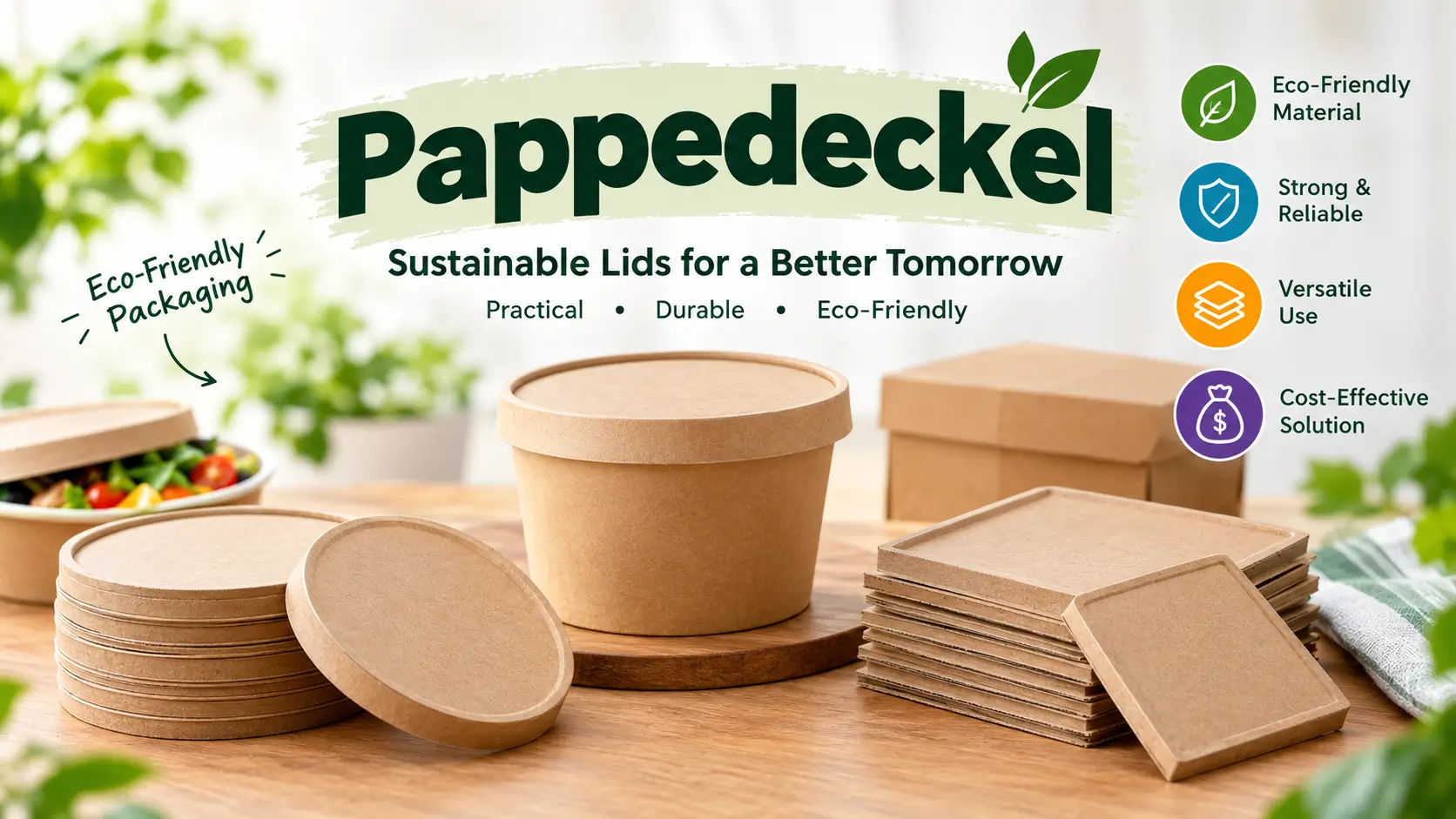
Some everyday objects are so familiar that people rarely stop to think about their names, materials, or purposes. A simple piece of cardboard is a good example. It may protect a product, cover a container, support a creative project, organize household items, or become part of a carefully designed package. The German-related term Pappedeckel brings these ordinary but useful applications into focus.
Although the word may look unfamiliar to English speakers, it is connected to cardboard and similar stiff paper-based materials. Depending on the context, it may describe a piece of cardboard, a cardboard cover, or an item associated with a lid or protective covering. This makes understanding the word particularly useful for readers interested in German vocabulary, packaging, printing, crafts, and everyday materials.
Pappedeckel is not necessarily the name of one specific manufactured product. It is better understood as a cardboard-related term whose intended meaning becomes clearer through the situation in which it is used. A person discussing a school project may be referring to a flat sheet of card, while someone talking about packaging might mean a protective cardboard cover. Regional language can add further variation.
Cardboard products also deserve more attention than they often receive. Their value depends on more than their simple appearance. Thickness, stiffness, surface quality, shape, moisture exposure, and intended use can all influence how effectively a piece of cardboard performs its function.
This guide explores the meaning of Pappedeckel, its linguistic background, its potential applications, the characteristics of cardboard materials, and the practical questions worth considering before choosing or using a cardboard component. It also includes illustrative case studies that show how different people and businesses might approach real-world situations involving cardboard covers and sheets.
By the end, readers will have a clearer understanding of the keyword Pappedeckel and why a seemingly simple material can have many practical applications.
What Does Pappedeckel Mean?
Pappedeckel is associated with the German words Pappe and Deckel. In broad terms, Pappe refers to cardboard or stiff paper-based material, while Deckel can refer to a lid or cover. The related standard forms Pappdeckel and Pappendeckel are defined as a piece of cardboard in German dictionary usage.
Consequently, an English translation of Pappedeckel may depend on the sentence in which it appears. Possible translations include cardboard, a piece of cardboard, cardboard cover, paperboard cover, or cardboard lid. These alternatives are related, but they do not always describe exactly the same object.
For example, a flat rectangular piece of cardboard placed beneath a lightweight item may fit the general material-based meaning. A shaped component designed to cover a container is more naturally described as a cardboard lid or cover. The material may be similar, but the object’s function determines the most appropriate description.
This distinction matters when researching Pappedeckel online. Some explanations focus narrowly on packaging lids, while others describe the wider meaning associated with cardboard. Neither interpretation should automatically be applied to every situation without considering its context.
Understanding the Main Components of the Word
The word becomes easier to understand when its parts are considered individually.
Pappe: This German word refers to cardboard or a relatively stiff paper-based material. Depending on the material and context, English translations may include cardboard, paperboard, or pasteboard.
Deckel: This word generally refers to a lid or cover. It suggests an object that closes, covers, or protects something else.
When combined, these elements suggest a relationship between cardboard and a covering object. However, compound words do not always have one narrow, literal meaning in everyday speech. The related word Pappdeckel, for instance, can refer to a piece of cardboard rather than exclusively to a manufactured lid.
For this reason, Pappedeckel should be interpreted according to its surrounding sentence and intended use.
Is Pappedeckel a Standard German Word?
Readers may encounter different spellings when searching for this term. Pappdeckel and Pappendeckel are established forms listed in standard German dictionary references. Pappedeckel is also recorded in regional German vocabulary, including Alemannic usage.
Regional vocabulary often differs from formal written German. A term may be familiar in one area while a different expression is preferred elsewhere. Pronunciation, spelling, and meaning can develop through everyday conversation and local traditions.
This does not make a regional expression meaningless or incorrect in its local setting. It simply means that formal writing, translation, and search optimization may require attention to the intended audience.
When writing an article about Pappedeckel, it is useful to recognize both the requested spelling and the related standard forms. This helps readers understand the keyword without incorrectly treating every spelling as interchangeable in every context.
The Background and Linguistic Significance of Pappedeckel
The linguistic interest surrounding Pappedeckel comes partly from the flexibility of regional speech. Languages are not used identically in every town, family, workplace, or social group. Local expressions often preserve older forms, introduce new meanings, or develop associations that are not immediately obvious to outsiders.
German contains many compound nouns, allowing speakers to describe objects by combining familiar words. Such constructions are practical because the component words offer clues about the subject being discussed. Yet those clues do not always provide a complete definition.
Pappedeckel illustrates this principle. Its relationship to cardboard and covering objects makes its meaning reasonably easy to approach, but its exact interpretation still depends on context.
Someone encountering the word in a craft discussion might understand it as a piece of stiff card. In a packaging conversation, the same expression could suggest a cover or lid. In a regional conversation, it may carry a familiar local meaning that differs slightly from the interpretation expected by a learner of standard German.
Why Regional Words Matter
Regional expressions are an important part of language because they reveal how people adapt communication to their surroundings. A word that is uncommon in formal publications may still be perfectly understandable within a local community.
Learning such expressions can help people communicate more naturally. It can also prevent misunderstandings when translating conversations, reading informal messages, or researching unfamiliar terms.
There are three useful principles to remember:
- Context matters: A word’s meaning becomes clearer when the surrounding sentence is considered.
- Spelling can vary: Regional speech does not always follow the spelling preferred in formal writing.
- Translation requires judgment: A literal translation may not be the most natural expression in the target language.
These principles are especially useful for Pappedeckel because an overly narrow translation may cause readers to assume that the word always refers to a purpose-made packaging lid.
Pappedeckel and Language Learning
For people learning German, Pappedeckel offers an opportunity to understand the difference between formal vocabulary and everyday regional expressions.
A learner might begin with the standard words Pappe and Deckel, then encounter related forms while reading articles, listening to conversations, or researching products. Rather than memorizing one translation, the learner can examine how the term functions within a sentence.
For example, consider the difference between these two hypothetical sentences:
- A person requests a piece of cardboard for a school model.
- A shopkeeper asks for a cardboard cover to close a package.
The first situation emphasizes the material. The second emphasizes the object’s function. Although both involve cardboard, a natural English translation may differ.
Understanding this distinction helps translators, language students, writers, and international businesses communicate more precisely.
What Is a Pappedeckel Made From?
When Pappedeckel refers to a physical cardboard object, its actual construction depends on the specific product. Cardboard is a broad category rather than one uniform material. Different grades are manufactured for different purposes, and they can vary substantially in thickness, stiffness, texture, and resistance to handling.
A simple cardboard sheet used for drawing does not necessarily have the same qualities as a rigid cover for a presentation box. Similarly, a paperboard component designed for dry packaging may be unsuitable for direct contact with wet food.
The best material is therefore the one that meets the requirements of the intended application.
Paper Fibres and Sheet Structure
Many cardboard products are made primarily from paper fibres. Those fibres are formed into sheets that may be pressed, layered, coated, or combined with other structures to obtain particular characteristics.
Depending on the product, the material may contain virgin fibres, recovered fibres, or a combination of different paper-based inputs. The manufacturing process influences the final appearance and performance.
Some types of board have a smooth finish suitable for printing. Others are designed to provide a firm, inexpensive surface for temporary use. Heavy-duty board can offer additional rigidity for protective packaging and structural applications.
A cardboard item’s appearance alone does not reveal every relevant property. Two pieces may look similar while behaving differently under pressure, moisture, or repeated handling.
Thickness and Stiffness
Thickness is one of the most noticeable characteristics of cardboard. Thin stock may be suitable for simple craft work or lightweight inserts, whereas thicker board can provide greater rigidity.
However, thickness should not be confused with complete strength. The type of fibre, sheet structure, manufacturing quality, dimensions, and direction of force can also affect performance.
When selecting a Pappedeckel for a particular task, ask what the object must withstand. A flat cover resting over a stationary box has different requirements from a lid that will be removed repeatedly during daily use.
The right specification balances protection, weight, cost, and ease of handling.
Surface Finish and Coatings
Cardboard surfaces may be left plain or treated to achieve a desired result. A smooth surface can improve printing quality, while a coated finish may influence appearance or resistance to certain conditions.
Some products use additional layers or coatings to provide properties such as grease resistance or moisture resistance. These features should never be assumed simply because an item is made from cardboard.
For food-related applications, the entire product must be suitable for its intended contact conditions. Buyers should check the manufacturer’s specifications rather than relying on appearance or the general description Pappedeckel.
This is particularly important when the material will touch food, hot beverages, oily products, or contents that could transfer substances from a coating.
Common Types of Pappedeckel and Cardboard Components
The term Pappedeckel does not identify one universal shape or specification. A product described this way might be a flat sheet, a fitted cover, a rigid panel, or another cardboard component.
Understanding the possible variations can make choosing the right object easier.
Flat Cardboard Sheets
Flat sheets are among the simplest cardboard products. They can be cut to size and used as backing material, temporary covers, separators, craft surfaces, or protective layers.
Their versatility makes them useful in homes, schools, studios, and small businesses. A sheet can be marked, trimmed, folded, painted, or attached to another material, depending on its composition.
A flat sheet is especially useful when the required shape is straightforward and precise measurements can be made before cutting.
Rigid Cardboard Covers
Rigid covers are designed to maintain their shape and provide a firmer surface than thin paper or lightweight card. They may be used for presentation boxes, storage containers, folders, display products, or protective packaging.
The degree of rigidity required depends on the load, size, and conditions of use. A larger cover may need additional support because its centre could bend if the material is too flexible.
Rigid board is often a practical choice when appearance and shape retention matter.
Cardboard Lids and Closures
A cardboard lid is designed to cover an opening or container. Depending on its construction, it may rest on top, fit around an edge, fold into position, or connect to another part of the package.
Not every cardboard cover creates an airtight or liquid-tight seal. Some simply reduce exposure to dust, provide a cleaner appearance, or keep lightweight contents from falling out.
The intended function should be established before selecting a lid. A cover for dry stationery requires different performance from a closure designed for food or moisture-sensitive products.
Printed and Decorative Covers
Printed cardboard covers combine practical functions with appearance. They can display a brand name, product information, decorative patterns, instructions, or other visual elements.
A well-designed printed surface can help a package appear more organized and recognizable. For gifts and retail products, it may also contribute to the experience of opening the package.
The design should remain appropriate for the product. Printing cannot compensate for weak construction, poor sizing, or an unsuitable material.
Custom-Cut Cardboard Pieces
Custom-cut pieces are made to match specific dimensions or shapes. They may be round, rectangular, square, irregular, or fitted to a particular object.
This approach is valuable when standard dimensions do not meet the requirements of a project. It is also useful for small production runs, prototype packaging, handmade products, and creative applications.
Before ordering custom pieces, it is sensible to test a sample. A small difference in fit can determine whether the cover works smoothly or becomes difficult to use.
Practical Uses of Pappedeckel in Everyday Life
Cardboard is often associated with shipping boxes, but its usefulness extends well beyond parcel delivery. A piece of suitable board can perform a simple task without requiring complicated equipment or expensive materials.
The specific applications of a Pappedeckel depend on its shape, finish, and strength.
Packaging and Product Protection
Packaging is one of the most obvious areas where cardboard covers and sheets can be useful. A fitted cover may keep loose items in place, while a flat insert can separate products inside a container.
Cardboard components can also help prevent minor surface contact between packaged objects. This is particularly relevant when products have finishes that might otherwise be scratched by rubbing against one another.
However, the protection offered by a cardboard component should be evaluated according to the risks involved. A small cover might be sufficient for stationery, but fragile glassware may need cushioning, a properly designed box, and additional protective materials.
Books, Folders, and Stationery
Rigid paper-based materials have long been useful in products where a stable surface is desirable. Book covers, folders, presentation boards, dividers, and document holders are familiar examples of this general application.
A firm cover can protect pages from ordinary handling and help a product retain its shape. A cardboard insert can also make a folder easier to use by giving it a more stable surface.
The exact material used in a finished product varies, but the underlying principle remains simple: appropriately selected board can support and protect lighter paper materials.
Arts, Crafts, and School Projects
For creative projects, cardboard is appealing because it can be cut and adapted with ordinary tools. It provides a surface for painting, drawing, construction, decoration, and model-making.
Children can use suitable cardboard to make simple shapes, miniature buildings, signs, picture frames, or classroom displays. Adults may use it for templates, prototypes, handmade decorations, or organizational projects.
A Pappedeckel used for a craft project does not need to be an expensive manufactured component. In many cases, a clean, undamaged piece of suitable cardboard will work well.
Basic precautions are still important. Sharp cutting tools should be used carefully, and materials that previously contained chemicals or other hazardous substances should not be reused for children’s activities.
Storage and Home Organization
Cardboard can provide inexpensive structure for lightweight storage. A firm panel may act as a divider, a cover can reduce dust exposure, and a flat piece can help separate objects within a drawer.
For instance, someone organizing sewing supplies might use cardboard dividers to distinguish threads, buttons, and small accessories. A hobbyist could create compartments for craft tools or use cardboard pieces to keep loose materials grouped together.
These solutions work best in dry environments. Cardboard can soften, warp, or lose strength when exposed to moisture, so it is not an ideal choice for damp storage areas or heavy loads.
Retail Displays and Product Presentation
Businesses may use cardboard covers and panels to create display supports, product dividers, price signs, or presentation packaging. Cardboard can be customized to fit a brand’s visual identity without requiring a permanently manufactured fixture for every purpose.
Small retailers may find it useful for temporary displays or seasonal arrangements. A carefully measured piece can separate products or create a neat visual boundary between sections.
For applications involving repeated handling, the business should consider whether a reusable or more durable material would provide better long-term value.
Pappedeckel in Food and Beverage Packaging
Food and beverage packaging is one area where cardboard-related components need particularly careful evaluation. A cardboard cover may be intended to keep dust away, separate items, provide a surface for labeling, or close a suitable container.
Nevertheless, not every piece of cardboard is safe for direct food contact, and not every cover is appropriate for hot, wet, greasy, or liquid products.
A product’s suitability depends on its material, any coatings or adhesives, manufacturing controls, and the conditions in which it will be used.
Choosing Food-Contact Materials
Food-contact packaging should be selected according to the food and the conditions of use. A cover designed for dry baked goods may not be appropriate for hot soup or oily food.
Before purchasing a Pappedeckel for a food business, consider:
- Whether the supplier identifies the product as suitable for the intended food-contact application.
- Whether the material can tolerate the expected temperature and contact duration.
- Whether grease or moisture may affect the cover’s shape or performance.
- Whether any coating, ink, adhesive, or treatment has the necessary suitability for the application.
- Whether the product closes securely enough for its intended purpose.
These questions are practical purchasing considerations, not optional details. A material should never be treated as food-safe merely because it looks clean or is made primarily from paper fibres.
Moisture and Heat Limitations
Ordinary cardboard can absorb moisture and lose stiffness. A damp surface may become weaker, and prolonged exposure can make a cover unsuitable for reuse.
Heat can also affect performance. Whether a cardboard component remains functional near a hot product depends on its design and material properties.
A business should therefore test the complete package under realistic conditions before using it in regular service. Testing should include the expected food or beverage, temperature, handling routine, and transport duration.
Can Cardboard Replace Plastic Lids?
In some applications, a suitably designed paper-based lid may serve as an alternative to a plastic component. However, replacement is not automatic.
The cardboard option must meet the necessary functional requirements, including fit, resistance to the contents, temperature tolerance, and performance during transport or storage.
A lid that looks attractive but leaks, becomes soft, or detaches too easily may create more problems than it solves. Likewise, a product with a specialized barrier coating may have different disposal requirements from an untreated paperboard component.
The best packaging decision considers performance, product safety, waste handling, and the real conditions of use together.
Advantages of Pappedeckel
When a suitable cardboard product is selected for a suitable purpose, it offers several practical advantages.
Lightweight Construction
Cardboard is generally convenient to transport and handle. A lightweight cover may be easier to store in bulk than a heavier alternative, and flat components can often be stacked efficiently.
The value of this characteristic depends on the application. A lightweight material is beneficial only when it still provides sufficient strength and protection.
Flexible Design Options
Cardboard can be manufactured or cut into different sizes and shapes. It can also be printed, folded, or combined with other materials where the design permits.
This flexibility supports a wide range of applications, from simple craft components to branded packaging.
Accessible for Small Projects
For household projects and prototypes, cardboard can be easier to obtain and work with than specialized manufactured materials.
A person testing a package design can create a basic mock-up from cardboard before committing to a finished product. Students and hobbyists can adapt suitable sheets to fit the size of a project.
Useful Surface for Printing and Labeling
Many cardboard surfaces accept printing or handwritten labels. This makes them useful for identifying contents, providing instructions, displaying brand details, and organizing supplies.
The print quality depends on the material and printing process. A rough or absorbent surface may produce a different result from a coated, smooth sheet.
Potential for Material Recovery
Suitable paper-based products can often enter paper or cardboard recycling systems, provided they are accepted by the local collection service and are not contaminated or made unsuitable by their coatings or construction.
However, recyclability depends on the specific item. A composite package, heavily contaminated cover, or coated material may require different handling from clean, untreated cardboard.
It is more accurate to evaluate the actual product and local disposal rules than to assume every Pappedeckel is automatically recyclable.
Limitations and Challenges of Cardboard Covers
The benefits of cardboard should be considered alongside its limitations. A material that performs well in one situation may fail in another.
Sensitivity to Moisture
Many untreated cardboard products are vulnerable to moisture. Water can penetrate the fibres, change the shape of the material, and reduce its stiffness.
For this reason, ordinary cardboard is not an automatic substitute for materials designed for wet conditions. If a product will encounter moisture, its suitability should be confirmed before use.
Variable Strength
Cardboard products differ in strength. Thin board can bend or tear when subjected to a load beyond its capabilities, while a thicker component may still perform poorly if it is badly supported or cut in an unsuitable direction.
Testing is particularly important for large covers, repeated-use items, and packaging that protects valuable goods.
Wear During Repeated Handling
A disposable cover may be designed for only one use. If the same component is opened, closed, bent, or handled repeatedly, it may eventually develop creases, torn corners, or a poor fit.
Where repeated use is expected, compare the cost of replacing cardboard components with the cost and practical advantages of a more durable alternative.
Limited Protection in Demanding Conditions
A flat piece of cardboard cannot provide the same protection as every purpose-built lid or structural enclosure. It may be inadequate against heavy impacts, serious pressure, liquids, or challenging transport conditions.
The required level of protection should be established before the material is selected.
Inconsistent Appearance
Reused cardboard may contain markings, discolouration, creases, or damaged edges. These imperfections may be acceptable for a prototype or home project but unsuitable for premium packaging.
Businesses that require a consistent visual standard should specify the required finish and inspect samples before placing larger orders.
How to Choose the Right Pappedeckel
Choosing a cardboard cover or sheet becomes simpler when the requirements are considered systematically. Instead of buying based on the name alone, identify the function the component must perform.
1. Define the Intended Purpose
Start by describing the task. Is the item intended to cover a container, protect a surface, support a document, separate products, or form part of a craft project?
A clear purpose helps narrow down the material and design requirements.
2. Measure the Required Dimensions
Measure the area or opening the cardboard component must cover. For a fitted lid, consider the dimensions of the container and how the cover is intended to sit in place.
Avoid assuming that an approximate fit will always be acceptable. A lid that is too small might not cover the opening, while one that is too large may be awkward to handle or transport.
3. Select Suitable Thickness and Rigidity
Consider whether the object needs to remain flat, support a light load, or withstand repeated handling.
Thickness and stiffness should be matched to the task rather than selected according to appearance alone. Where performance is uncertain, request a sample or create a small prototype.
4. Evaluate Environmental Conditions
Think about moisture, temperature, dust, sunlight, and expected handling.
A component used indoors for a short period may need relatively simple characteristics. Packaging exposed to damp conditions or long journeys may require a different construction.
5. Check Material Compatibility
If the cardboard will touch food, cosmetics, chemicals, or other sensitive contents, verify that the complete product is appropriate for that use.
Do not assume that a cardboard component is suitable merely because its main material is paper-based.
6. Consider Appearance and Branding
For customer-facing packaging, the surface finish and consistency may be important. Ask whether the product can be printed, cut accurately, or produced in the required colour and shape.
A simple design often works well, but the finish should match the expectations associated with the product being sold.
7. Compare Total Cost
Purchase price is only one part of the total cost. Other considerations include storage, assembly, damaged items, transport, disposal, and replacement frequency.
A cheaper component may become less economical if it fails during routine use. Conversely, an expensive custom design may be unnecessary for a simple temporary task.
8. Test Before Scaling Up
Where the component plays an important role, test it under the conditions in which it will actually be used.
Check fit, durability, appearance, and ease of handling. For packaging, test the complete package rather than evaluating the cover in isolation.
This helps identify weaknesses before a product is ordered in large quantities or introduced into regular business operations.
Environmental Considerations and Responsible Disposal
Cardboard is often associated with more sustainable packaging because it is paper-based and may be recoverable through established recycling systems. However, environmental performance depends on the complete product lifecycle rather than material appearance alone.
It is important to distinguish between a product being made from cardboard, being reusable, being recyclable, and having a lower overall environmental impact. These are related but different characteristics.
Reuse Where Practical
A clean, undamaged cardboard piece may be suitable for a second task. For example, it might become a drawer divider, protective layer, packaging insert, or craft material.
Reuse is most useful when the item remains fit for purpose and does not create a safety or hygiene problem.
Food-contact components, contaminated materials, and items previously exposed to hazardous substances should not automatically be repurposed.
Understand Recycling Requirements
Local recycling rules may differ. Some services accept common cardboard materials but exclude heavily contaminated items, composite structures, or certain coated products.
Before placing a Pappedeckel in a recycling bin, check the requirements of the local waste collection system.
Where a package has multiple components, separate them when appropriate and permitted. A clean cardboard panel should not automatically be treated as equivalent to a laminated or heavily contaminated product.
Reduce Unnecessary Packaging
A sensible packaging design uses only the materials required to protect and present the product.
An oversized cover, excessive inserts, or unnecessary layers can increase material use without improving performance. On the other hand, removing too much material may allow products to become damaged, creating additional waste.
The objective should be to balance adequate protection with reasonable material use.
Be Careful With Environmental Claims
Businesses should avoid describing every cardboard product as environmentally friendly without considering how it is manufactured, used, and disposed of.
A responsible assessment considers the sourcing of fibres, recycled content where relevant, manufacturing requirements, product lifespan, transport, coatings, and local waste infrastructure.
Clear, specific claims are more informative than broad labels. For example, describing a package as made from a specified paper-based material is more precise than promising that it will have no environmental impact.
Illustrative Case Studies: Pappedeckel in Different Situations
The following case studies are hypothetical examples created to demonstrate practical decision-making. They are not accounts of verified businesses, measured financial results, or independently documented experiments.
Case Study 1: A Small Café Reviewing Its Takeaway Packaging
Imagine a neighbourhood café that serves hot drinks and takeaway snacks. The owner wants to review the packaging used during busy periods and is considering cardboard-based components.
The first step is to identify the problem. Perhaps the café wants a particular presentation style, improved product identification, or packaging that better fits its waste-management approach. Each objective suggests a different set of requirements.
The owner should then examine the specific products available. A cardboard cover might be suitable for a dry-food container, while a hot drink requires a component designed and verified for that beverage and cup configuration.
The café could order a small sample selection and test each option with its normal menu. Staff could assess whether the covers fit securely, remain functional during ordinary handling, and are convenient to apply.
A useful evaluation would include the following:
- Fit with the intended container.
- Performance with the actual food or beverage.
- Ease of handling during busy service.
- Appearance after ordinary use.
- Supplier documentation and disposal guidance.
This approach reduces the chance of choosing packaging solely because it appears attractive or environmentally preferable. It also demonstrates that the term Pappedeckel is only a starting point; actual product specifications determine whether a component is suitable.
Case Study 2: An Online Seller Improving Small-Product Packaging
Consider a small online business that sells stationery, handmade accessories, or lightweight household items. Products occasionally shift inside their packages, and the seller wants to organize the contents more effectively.
A cardboard insert or fitted cover may help separate items or keep them in position. The business begins by measuring the products and the available space inside its existing packaging.
It then creates several prototypes with different shapes and degrees of rigidity. Each prototype is placed inside a representative package, and the seller checks whether the contents remain organized during normal handling.
The seller also considers the unpacking experience. A package should be easy to open without requiring excessive force or damaging the product.
The decision should not be based on the appearance of the cardboard piece alone. An insert that takes too long to assemble may be impractical during busy periods. A cover that is difficult to remove may frustrate customers, while an undersized insert may fail to keep items separated.
A successful design would balance practical protection, ease of assembly, reasonable material use, and the presentation expected by customers.
This example shows how a simple cardboard component can contribute to a more organized packaging system without needing to be a complicated product.
Case Study 3: A Teacher Planning a Classroom Craft Activity
Imagine a teacher preparing a project in which students construct miniature buildings from recycled craft materials. The teacher collects suitable cardboard sheets and cuts them into panels for walls, roofs, doors, and signs.
In this situation, the material does not need to provide a commercial packaging seal. Instead, it needs to be manageable for students, reasonably stiff, and easy to decorate.
Before beginning, the teacher checks that the collected cardboard is clean, dry, and appropriate for classroom use. Materials with sharp edges, contamination, or unknown hazardous residues are excluded.
Students can then plan their designs, measure the required pieces, and arrange the panels before attaching them. This introduces practical skills such as measurement, material selection, construction, and creative problem-solving.
The activity also helps explain why cardboard quality matters. A very thin sheet may bend when used as a wall, while a thicker piece may be easier to position but harder to cut.
The best choice depends on the students’ ages, available tools, and the model’s design. The teacher can use offcuts for small details rather than discarding every unused piece.
Here, Pappedeckel illustrates the broader usefulness of stiff paper-based materials: the value lies in selecting the right form for the intended activity.
Common Mistakes to Avoid When Using Pappedeckel
A few common mistakes can reduce the usefulness of cardboard components. Avoiding them is usually easier than correcting a poorly chosen product later.
Assuming Every Cardboard Product Is the Same
Cardboard ranges from thin, flexible sheets to firm, layered board. Its performance depends on construction and intended use.
Always check the actual material rather than assuming that all products described as cardboard have the same properties.
Confusing a Cover With a Seal
A cover does not necessarily create an airtight, watertight, or tamper-resistant closure. Some components simply cover an opening or protect against ordinary dust and handling.
Where the package must contain liquids, maintain freshness, or provide a controlled seal, use a product specifically designed for that purpose.
Ignoring Measurements
An incorrectly sized piece may be difficult to install or fail to cover the intended area. Accurate measurements are particularly important for lids, fitted inserts, and custom packaging.
Create a sample before committing to a larger quantity whenever dimensional accuracy is important.
Choosing Material Based Only on Price
The cheapest component may not deliver adequate protection or durability. Damage, replacements, assembly time, and customer complaints can affect the overall value of a purchase.
Compare products on the basis of the job they must perform, not just their initial cost.
Making Unverified Recycling Assumptions
A cardboard-based product may contain coatings, adhesives, or additional materials that influence its disposal route.
Check local guidance and product information rather than assuming that every item belongs in the same recycling stream.
Using the Wrong Spelling in Every Context
When researching Pappedeckel, remember that related forms exist. Pappdeckel and Pappendeckel are established standard forms, while Pappedeckel is documented in regional usage.
Writers should preserve the target keyword where appropriate, but readers should also receive enough context to understand the relationship between these forms.
How Pappedeckel Fits Into Modern Product Design
Modern product design often involves balancing cost, functionality, appearance, and material use. Cardboard components can contribute to these goals when their capabilities match the requirements.
For a basic product, a simple cover may be enough. A premium retail item might need a more carefully finished surface. A component used during shipping could require extra structural support or a more protective overall package.
The important principle is that the design should begin with the problem being solved.
Designing for Function
The first question should be what the component needs to accomplish. It may need to cover an opening, prevent loose contents from moving, protect a surface, or provide a place for a label.
Each objective affects the appropriate shape, dimensions, and material.
Designing around the function also prevents unnecessary complexity. A complicated component is not automatically better than a simple one if both provide the same required performance.
Designing for Ease of Use
Customers and staff should be able to handle the item comfortably. A cover that is awkward to fit or remove can slow down packaging or create frustration.
Prototypes can help reveal practical difficulties before manufacturing begins. A small change to a corner, tab, fold, or opening may make a product significantly easier to use.
Designing for End of Life
Where possible, product designers should consider what happens after the component has served its purpose. Can it be reused? Can it be separated from the rest of the package? Are the materials accepted by local recycling systems?
These questions are especially important when a product combines cardboard with coatings, plastic films, adhesives, or other components.
An effective design does not simply look good when purchased. It also considers use, handling, and disposal.
The Future of Cardboard Components
Cardboard remains relevant because it can be adapted to many straightforward tasks. Product designers, packaging teams, educators, and households can use paper-based materials in different ways depending on their needs.
Future developments may include improved structural designs, more carefully specified barrier materials, easier-to-recycle constructions, and packaging components tailored to particular products. The availability and performance of any innovation will depend on the manufacturer and intended application.
It is important, however, not to treat every cardboard cover as a new technology or a guaranteed replacement for other materials. Pappedeckel is a broad, context-dependent term rather than the name of one universal invention.
The more meaningful question is whether a specific cardboard product solves a real problem effectively. Does it fit? Does it offer adequate protection? Is it practical to manufacture, transport, use, and dispose of? Can it meet the relevant product-safety requirements?
These questions provide a more useful basis for evaluating a component than a claim that one material is always superior to every alternative.
Why Pappedeckel Is Worth Understanding
Pappedeckel is an interesting keyword because it connects language, materials, and practical everyday applications. Its meaning cannot always be reduced to one English translation, and its interpretation may depend on whether the discussion concerns German vocabulary, a flat piece of cardboard, or a covering component.
That flexibility is also a reminder that materials should be evaluated in context. A piece of cardboard can serve as a craft surface, a backing panel, a package insert, or a lid, but each application creates different requirements.
For everyday use, the most important considerations are straightforward: identify the task, choose a suitable material, measure carefully, check any relevant safety requirements, and test the finished component when performance matters.
Environmental claims should receive the same attention. Cardboard may be reusable or recyclable in suitable circumstances, but the outcome depends on the actual product and local waste facilities. Responsible decisions come from examining those details rather than relying on a generic label.
For readers learning German, Pappedeckel also provides a useful example of how regional vocabulary can differ from standard written forms. Recognizing that variation makes translation more accurate and helps prevent a narrow interpretation of an unfamiliar word.
Ultimately, the value of Pappedeckel lies in understanding what the word means in a particular situation and what the associated cardboard object is expected to do. Whether the interest comes from language learning, packaging, craft work, or product design, that context-first approach leads to clearer communication and better practical choices.
Frequently Asked Questions About Pappedeckel
1. What does Pappedeckel mean in English?
Pappedeckel is a German-related, cardboard-associated term. Depending on context, it may be translated as cardboard, a piece of cardboard, a cardboard cover, or a cardboard lid. The best translation depends on the object and sentence being discussed.
2. Is Pappedeckel the same as Pappdeckel?
The words are closely related, but their spelling and usage differ. Pappdeckel is a standard German dictionary form, and Pappedeckel is documented in regional usage. It is useful to consider the context rather than assume that every spelling has precisely the same application.
3. What is a Pappedeckel made of?
When the term describes a physical item, it generally refers to cardboard or a related stiff paper-based material. The actual composition may vary according to the product, including its fibre content, thickness, surface finish, and any additional coatings or layers.
4. Is Pappedeckel always a cardboard lid?
No. Although the word may be interpreted as a cardboard cover or lid in some contexts, it can also refer more generally to a piece of cardboard. A flat sheet used for crafts and a fitted packaging lid have different functions, even if both are made from similar materials.
5. Where can Pappedeckel be used?
Potential applications include packaging, storage, stationery, book covers, product presentation, craft projects, classroom activities, and protective inserts. The suitability of a particular item depends on its dimensions, rigidity, surface properties, and intended use.
6. Is Pappedeckel environmentally friendly?
A cardboard-based item may offer reuse or recycling opportunities, but environmental performance depends on its materials, manufacturing, lifespan, coatings, transport, and disposal route. It is more accurate to evaluate the specific product than to assume that all cardboard components are automatically environmentally friendly.
7. Can Pappedeckel be recycled?
Some cardboard products are accepted in paper and cardboard recycling collections. Acceptance depends on local rules and the product’s condition and composition. Contamination, coatings, laminations, or combined materials may affect whether a particular item can be recycled.
8. Can Pappedeckel be used for food packaging?
Some cardboard-based products are suitable for specified food-contact uses, but not every piece of cardboard is appropriate. Check that the complete product is designed for the relevant food, temperature, contact duration, and handling conditions before using it in a food business.
9. What should I consider when buying a cardboard cover?
Consider the intended purpose, dimensions, thickness, rigidity, surface finish, environmental conditions, and required durability. For food-related applications, also verify suitability for the intended contact conditions. Testing a sample can help confirm fit and performance before ordering a large quantity.
10. Can Pappedeckel be used for DIY projects?
Yes, suitable clean cardboard can be useful for many DIY and craft projects. It can be measured, cut, folded, painted, decorated, or assembled into models and organizers. Choose a material that suits the project’s size and structural requirements, and handle cutting tools carefully.
11. Is there a difference between cardboard, paperboard, and pasteboard?
These terms overlap, and their precise technical meanings may vary by industry and product specification. In general, they refer to paper-based materials with different thicknesses, constructions, or intended functions. When purchasing a component, its actual specification is more informative than a broad material label.
12. Why does context matter when translating Pappedeckel?
Context determines whether a sentence emphasizes a material, a flat piece of card, or a cover that performs a particular function. A literal translation may be understandable but sound unnatural in English. Looking at the surrounding sentence helps the translator choose the most accurate expression.
13. How can I make a simple cardboard cover?
Measure the area or opening to be covered, choose suitable cardboard, and mark the dimensions carefully. Cut the material using an appropriate tool and check the fit before finishing the edges. For products that require precise sealing, food-contact suitability, or demanding performance, use a purpose-designed component instead of relying on a homemade cover.
14. Is Pappedeckel a brand name?
The term is best understood as a cardboard-related word rather than the name of one universally recognized manufactured product. A particular business could use it in a product name or brand context, but the word alone does not identify one specific manufacturer or standardized design.
15. Why is Pappedeckel an interesting term to research?
It brings together German vocabulary, regional language variation, cardboard materials, packaging, and practical everyday uses. Understanding its different interpretations helps readers translate it more accurately and recognize that a cardboard-related term can describe different objects depending on context.
Final Thoughts
Pappedeckel may appear to be a simple word, but its meaning opens the door to several useful subjects. It demonstrates how regional language and standard vocabulary can overlap, while also highlighting the versatility of cardboard in everyday life.
From packaging covers and protective inserts to stationery and creative projects, cardboard components can serve many functions when their material properties match the task. Their limitations are equally important: moisture, repeated handling, unsuitable coatings, and poor sizing can all affect performance.
For the best results, start with the intended use, check the actual material and dimensions, and test the component when reliability is important. Evaluate environmental claims carefully, especially when coatings or multiple materials are involved.
Understanding Pappedeckel is ultimately about more than finding a single translation. It is about interpreting a word in context and recognizing how a simple material can serve different purposes across language, business, education, and daily life.
For More Visits: Biz Nity
Also Read: CrackStreams 2.0: Safety, Risks & Legal Alternatives
